
Derrick Alcott | April 16th, 2017
Throughout the course of history, we have practiced some pretty strange medical treatments in attempts to cure what ails us. In the days before modern science and technology, a trial-and-error approach to discovering effective treatment was understandable. Decades or centuries ago, patients could have experienced the draining of a portion of their blood to remove bad stuff, disconnecting parts of the brain to cure mental illness, implantation of goat testes to cure male infertility, the now infamous snake oil to cure lots of things, placing egg-shaped gem stones in a woman’s vagina to improve sexual health, ingesting small doses of poison to cure a wide range of ailments, or stabbing many small needles into skin to alleviate pain… Actually, those last three remain in practice today. So why, in the age of modern medicine, do people still turn to these alternative practices?
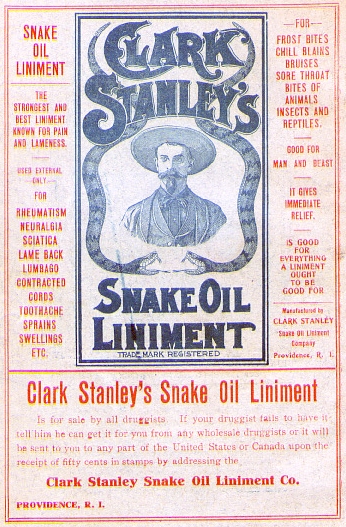
Fig. 1 – An advertisement for Clark Stanley’s snake oil. If you look closely, you’ll notice that it claims to cure an incredibly wide range of ailments.

Fig. 2 – A modern diagram of the mythical meridians used in acupuncture treatment.
According to the National Health Interview Survey, Americans alone spend over $30 billion per year [1] on alternative medicines such as acupuncture [2], homeopathy [3], chiropractic [4], and “natural supplements”, which have little to no evidence of efficacy. But “so what if my acupuncturist isn’t actually correcting my qi through meridians? I feel good after, and that’s all that matters, right?” There’s a problem with this thinking which can be applied to all forms of alternative medicine. While I fully support the idea of utilizing the incredibly powerful placebo effect to improve a patient’s symptoms, if the benefits of a treatment are no better than placebo, then is it worth it to risk potential negative health effects associated with alternative treatments?. That, in essence, is the issue with many “alternative medicine” practices. The risks associated with some of these practices are often under-reported [5] and can be severe [6], while much safer, and often cheaper, options can provide equivalent benefits.
When considering any medical option, it is important to weigh the likelihood of a positive outcome against the likelihood of a negative outcome, as well as the severity of the potential outcomes. Even taking an aspirin to alleviate headache symptoms, for example, comes with some risks. The likelihood of a negative outcome from taking aspirin at a proper dosage for occasional pain is extremely low, the patient is very likely to experience moderate benefits beyond placebo effect, and it is inexpensive – a reasonable choice. When a proposed medical option has the potential to cause debilitating or even life-ending injuries, has no evidence of actually providing the benefits that the patient seeks, and is expensive, there are likely far better options.
The rise of evidence-based medicine
The early 1990’s marked the beginning of the evidence-based medicine (EBM) movement [7]. Upon hearing this, my first thought was: what other kind of medicine could there be? If medicine wasn’t based on evidence before, what in the world was it based on? It turns out, the opinions and experiences of established medical professionals carried considerable weight in developing courses of treatment, while hard evidence on the effectiveness and risks of those treatments were not always measured, and were sometimes even ignored, in favor of conventional wisdom. It wasn’t until the 1990’s that medical researchers started to take a good hard look at the effectiveness of long-held beliefs about a variety of medical practices. By conducting systematic reviews of large numbers of robust, well-designed, controlled randomized trials, researchers started to uncover common medical practices that were not benefiting patients (but were costing them money and potentially negative side effects).
Injections of cement into a fractured vertebra to cure back pain, coronary stenting for mild issues like the gradual restriction of arteries as we age, and surgically scraping away scar tissue from a meniscus to alleviate knee pain are three examples of modern medical practices that have recently been proven to be ineffective through the analytical procedures of evidence-based medicine [8]. Unfortunately, cases like this where doctors admit that a medical practice has not been helping their patients, but instead has been costing them large sums of money and potentially negative side effects, gave some members of the public a perception that doctors don’t know what they are doing. This has played a role in the growing mistrust of medical professionals [9]. While this may seem like a natural reaction to a disheartening realization, consider the alternative: doctors discover that a treatment is not effective, but rather than admit this and halt further use of the procedure, they hold fast to their original beliefs and continue to allow patients to pay for ineffective and potentially damaging treatments. Or worse, doctors never investigate whether their treatments work at all. Now, *that* would be a reason not to trust a medical professional. Modern medicine (and science in general) operates on the current best available knowledge, continually altering beliefs and practices as better evidence becomes available. Unfortunately, the misguided lack of trust in doctors derived from such medical reversals has created a demand for a different type of medicine.

Fig 3 – Evidence-based medicine considers all the evidence of a treatment’s effectiveness with greater weight given to information obtained through more reliable sources, such as meta-analyses (an analytic review of a large number of published studies on a topic) or randomized control trials, than less reliable sources like individual cases or expert opinions. Source: University of Central Michigan Libraries
The rise of alternative medicine
Let’s take a step back and look at the word “medicine”. There is no requirement that medicine be provided by a medical doctor or that it be some sort of pharmaceutical. Medicine is defined by the Oxford English Dictionary as “the science and practice of the treatment and prevention of disease.” Simply put, if it improves your health, then it is medicine. So, what is alternative medicine? In my opinion, and as the name suggests, alternative medicine is an alternative-to-medicine. Therefore, alternative medicine is something that does not actually improve your health but that someone wants to sell to you as medicine anyway; if it worked, it would simply be medicine and would fall into the realm of contemporary evidence-based medicine. Alternative medicines are diverse in substance but often share common features such as claiming to cure an exceptionally wide range of ailments, not providing a testable mechanism for how the treatment works on any of these ailments, and claiming to be “all natural”, whatever that means (can someone please tell me what is natural about sticking a rock in your vagina or swallowing inordinate amounts of ground fish condensed into pill form?).
Conclusion
Evidence-based medicine is simply focused on understanding which practices truly improve health and which do not. This means that sometimes medical professionals will develop new views about a given medical practice as more and higher quality evidence becomes available. There is no bias for pharmaceuticals or objection to “natural” remedies. In fact, healthy diet and exercise continue to reign supreme as one of the most beneficial evidence-based practices for overall good health. The rise of alternative medicine is a consequence of reversals of previously touted medical practices that were discovered to be ineffective, amongst other factors. There are many medical practices for which the EBM jury is still out because sufficient evidence is not yet available (and because studying these things effectively is incredibly challenging). However, when there is substantial evidence that a particular medical practice does not provide any health benefits, but does impart some risk and costs, you’re not doing yourself any favors by sticking with it. The way we look back on grandpa’s generation with bewilderment as to why they ever believed that goat testes could cure human infertility is likely how future generations will look at even the most popular alternative medicines today. While the evidence-based medicine approach does have its drawbacks, it is the current gold standard for how to maximize your health outcomes and avoid being swindled by modern snake oil salesmen.
References
1. National Health Interview Survey. 2012. National Center for Complementary and Integrative Health.
2. “Acupuncture is theatrical placebo”. 2013. Colquhoun, D. and Novella, S. Anesthesia and Analgesia, 116(6).
3. “Homeopathy is Unscientific and Unethical“. 2012. Smith, K. Bioethics. 26 (9): 508–512. doi:10.1111/j.1467-8519.2011.01956.x.
4. “An epidemiological examination of the subluxation construct using Hill’s criteria of causation.” 2009. Mirtz TA, Morgan L, Wyatt LH, Greene L. Chiropractic & Osteopathy, 17:13, 2009.
5. “The reporting of adverse events following spinal manipulation in randomized clinical trials-a systematic review“. 2016. Gorrell LM, Engel RM, Brown B, Lystad RP Spine J. Systematic Review, 16 (9): 1143–51. doi:10.1016/j.spinee.2016.05.018.
6. “Deaths after chiropractic: A review of published cases”. 2010. Ernst E. International Journal of Clinical Practice, 64(8): 1162-1165. doi: 10.1111/j.1742-1241.2010.02352.x.
7. Evidence-based medicine. A new approach to teaching the practice of medicine. 1992. Evidence-based medicine working group, JAMA 4;268(17):2420-5.
8. “Bad Medicine, Part 1: The story of 98.6 “. 2016. Freakonomics Radio Podcast by Stephen J. Dubner.
9. “Public Trust in Physicians – U.S. Medicine in International Perspective”. 2014. Robert J. Blendon, Sc.D., John M. Benson, M.A., and Joachim O. Hero, M.P.H. The New England Journal of Medicine, 371: 1570-1572.